
News + Blog
Earth Day Spotlight: Jason deCaires Taylor and the Power of Art to Restore Oceans
Request to license artwork | Join our mailing list to learn more about licensing artwork
In celebration of Earth Day, it is an opportune moment to consider the evolving role of artists in addressing the ecological challenges of our time. Among the most compelling voices working at the intersection of art and environmental stewardship is Jason deCaires Taylor, whose pioneering underwater sculptures have redefined the possibilities of contemporary practice.
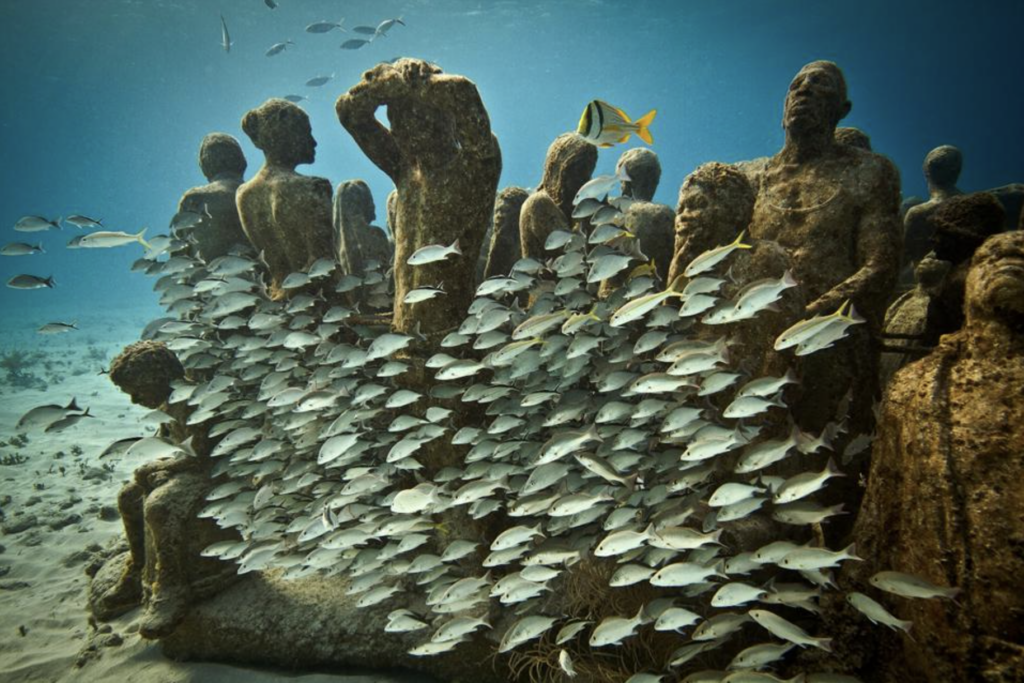
Silent Evolution, MUSA, Mexico © Jason deCaires Taylor. All rights reserved, DACS / ARS 2026
Over the past two decades, Taylor has developed a singular body of work that exists not within the traditional confines of the gallery or museum, but beneath the surface of the ocean. Installed in coastal waters across the Caribbean, Mexico, and Europe, his large-scale sculptural installations are designed to function as artificial reefs—living systems that foster marine biodiversity while simultaneously serving as powerful visual statements.
Constructed from pH-neutral, marine-grade materials, Taylor’s sculptures are engineered to encourage coral growth and provide habitat for a wide range of aquatic species. Over time, these works are transformed by their environments: surfaces become encrusted with coral and algae, forms soften and shift, and the sculptures themselves are gradually absorbed into the ecosystems they were created to support. In this way, Taylor’s practice challenges traditional notions of permanence in sculpture, instead embracing change, decay, and regeneration as essential components of the work.
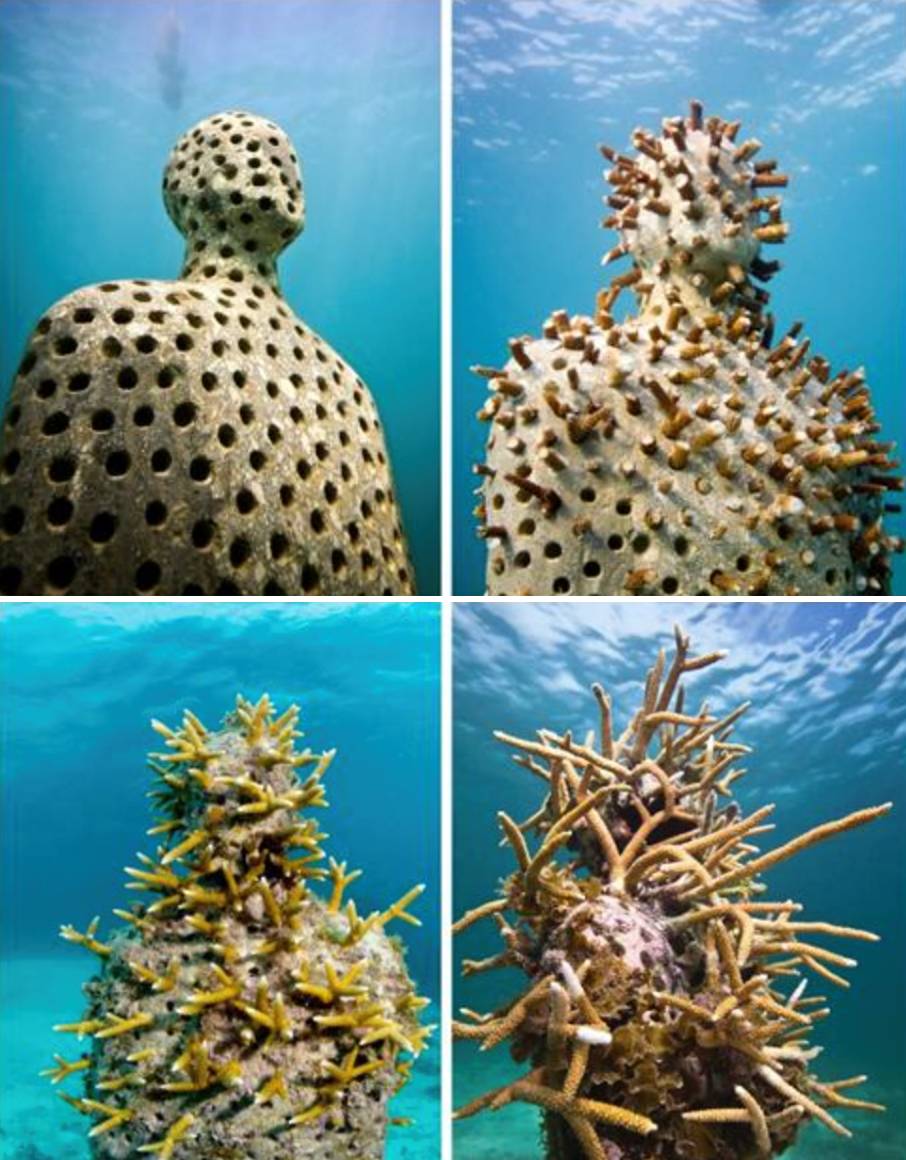
Coral Progress, Holy Man, MUSA, Mexico © Jason deCaires Taylor. All rights reserved, DACS / ARS 2026
Yet beyond their ecological function, these submerged figures carry a profound conceptual weight. Often depicting human subjects in contemplative, communal, or introspective poses, Taylor’s installations explore themes of climate change, environmental degradation, and the fragile relationship between humanity and the natural world. Their placement beneath the water’s surface invites both physical and metaphorical immersion, encouraging viewers to reconsider their position within broader ecological systems.
Projects such as the Museo Subacuático de Arte (MUSA) in Mexico and the underwater museum off the coast of Lanzarote have drawn international attention not only for their artistic innovation, but also for their role in promoting sustainable tourism. By diverting visitors away from vulnerable natural reefs and toward these man-made environments, Taylor’s work demonstrates how cultural production can actively contribute to conservation efforts.
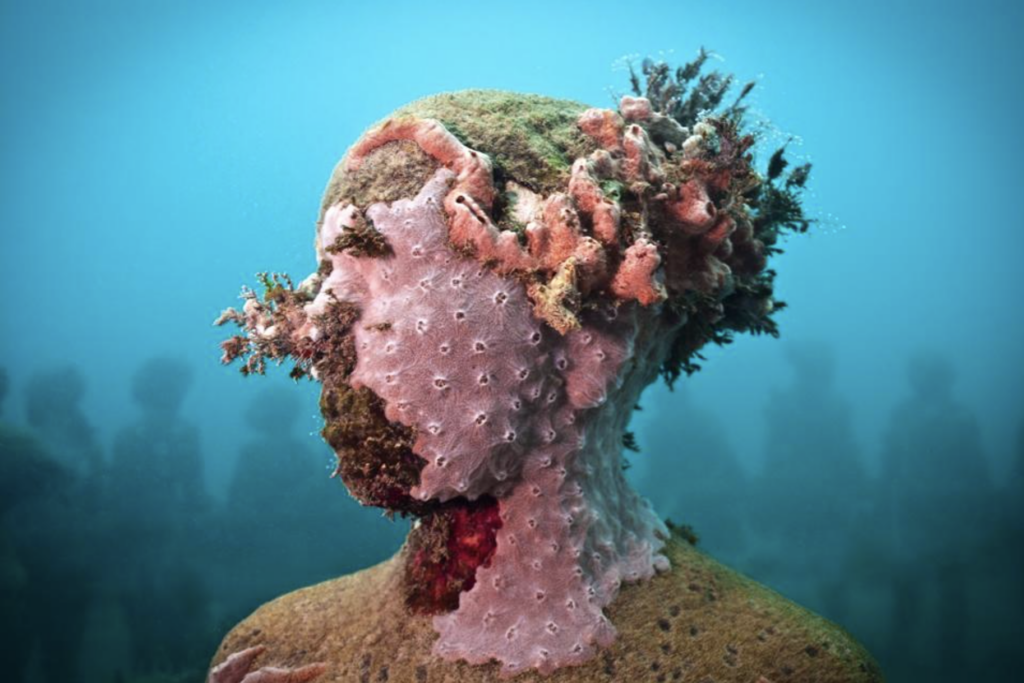
Vicissitudes, Grenada © Jason deCaires Taylor. All rights reserved, DACS / ARS 2026
In bridging the disciplines of sculpture, environmental science, and public engagement, Jason deCaires Taylor has established a model for what art can achieve in the twenty-first century. His work underscores the potential for creative practice to move beyond representation and into direct participation—serving not only as a reflection on the natural world, but as a means of restoring it.
Artists Rights Society is proud to support the responsible stewardship and wider dissemination of Taylor’s work, ensuring that its environmental vision continues to inspire audiences and contribute meaningfully to conversations around sustainability and the future of our oceans.
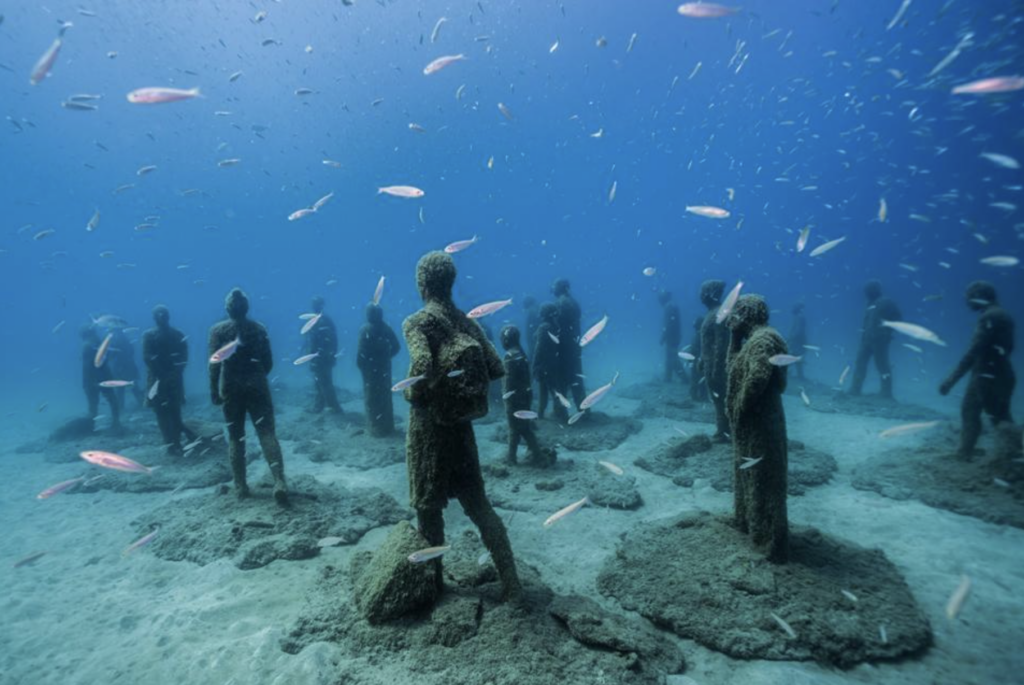
Crossing the Rubicon, Museo Atlántico, Lanzarote, Spain © Jason deCaires Taylor. All rights reserved, DACS / ARS 2026
ARS helps ensure that all reproductions of Jason deCaires Taylor’s works adhere to our highest standards and proper authorization. When submitting a licensing request, several steps must be followed, which may differ slightly based on the project type. These steps include:
- Gather the details of your request, such as the title and year of the work(s) you wish to license.
- Consider where you will obtain a high-resolution image file. ARS does not provide images but only the copyright clearances.
- Create a project layout, showing how the work will appear within a book, social media post, advertisement, or product.
- If your use involves video, film, or TV, include details on the screen time of the image and whether it is ‘referenced’ by actors or ‘not referenced.’
- Note that image manipulation and cropping are generally discouraged.
- Remember to feature the appropriate credit line in your project.
- The process for obtaining permissions can take time, and ARS may request additional information.
Whether you’re planning an exhibition, commercial endeavor, or creative collaboration, licensing artwork requires attention to artistic integrity and legal considerations. Partnering with Artists Rights Society is essential to secure the appropriate license for Alma Thomas’ art, ensuring compliance with copyright law and upholding her artistic vision. Our licensing executives are ready to assist you throughout this process. Submit a request to kickstart your project and secure a license with Artists Rights Society!
Request to license artwork | Join our mailing list to learn more about licensing artwork